Salt Before Sleep: The Armenian Love Biscuit That Summons A Dream
© Dining in Diaspora
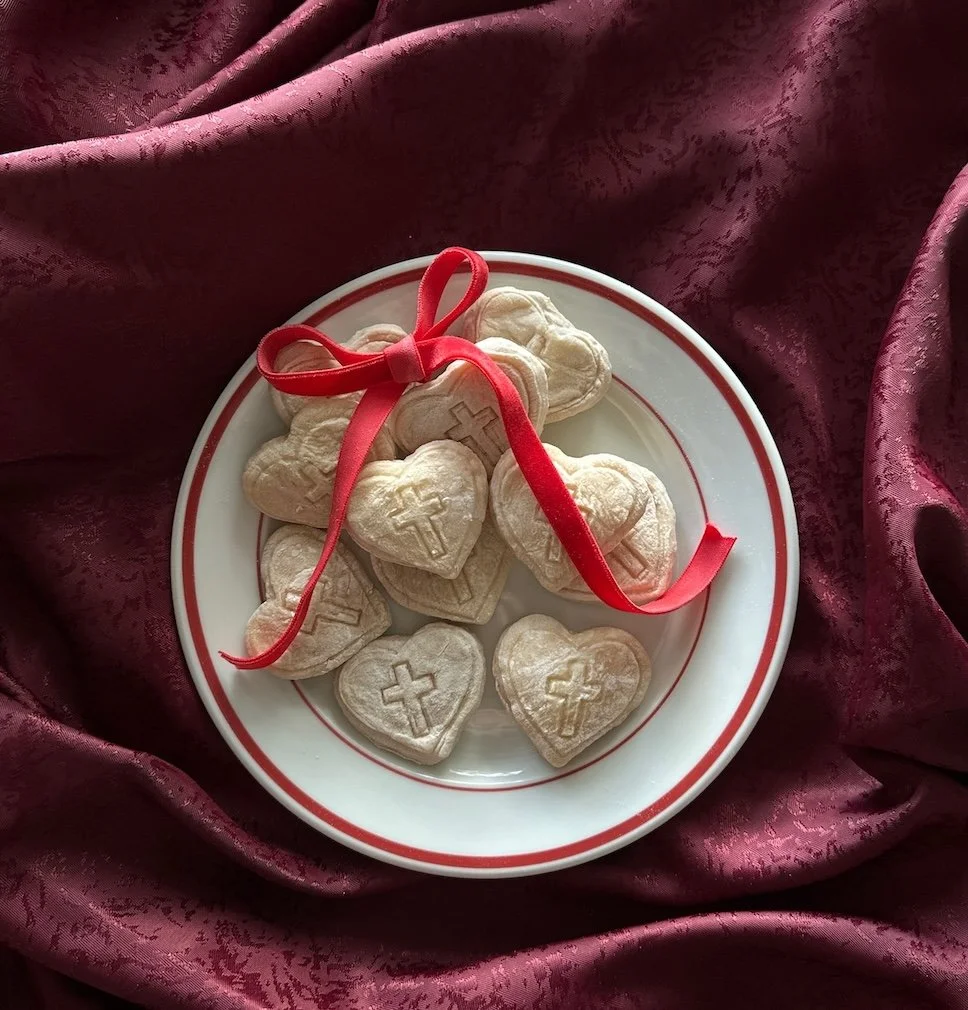
It is barely a recipe: flour, water, salt. No sugar. No oil. No yeast. Basic ingredients said to bring you the love of your life through a salty Armenian biscuit associated with a martyr.
St. Sarkis is sometimes described as Armenia’s answer to Valentine’s Day, though his feast is observed in late January or early February, depending on the year. On the eve of St. Sarkis, unmarried young people eat this deliberately salty biscuit — known as աղաբլիթ (aghablit), and go to bed without drinking water. The point is to wake up thirsty. Folklore holds that whoever appears in their dream offering a glass of water will be their future spouse.
St. Sarkis — or Sargis — was a 4th-century military commander in the Roman army, believed to have been of Greek origin from Cappadocia, in what is now central Turkey. A Christian convert, he was executed under Emperor Julian the Apostate and later canonized. Historically, he was a martyr. But in Armenian tradition, he became something else: a swift rider who aids young lovers, a saint associated with love and devotion.
© Dining in Diaspora
Over centuries, Armenians layered local meaning onto his feast day. This simple biscuit became part of that layering, ritual food designed not to nourish but to provoke thirst, and therefore dreams.
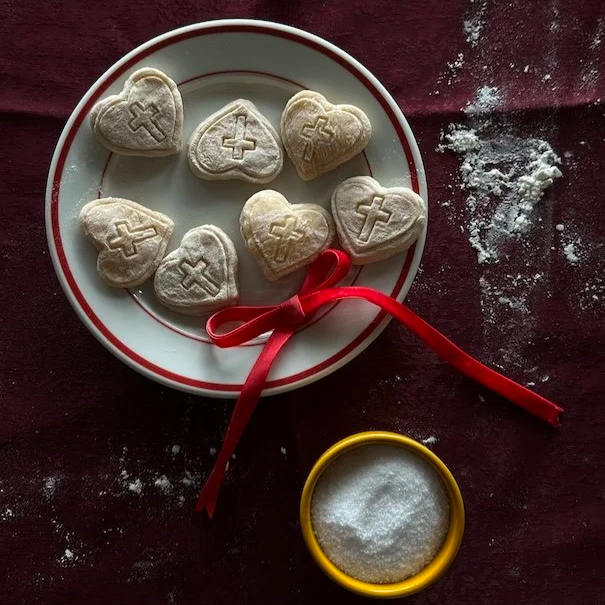
In Armenia, another custom accompanies the night: families may sprinkle flour or sand outside their doorsteps. By morning, children look for the imprint of a horse’s hoof, a sign that St. Sarkis has passed by on horseback, bringing blessings to the home. The image of this saint, searching, riding, and moving between worlds, reinforces the idea that love, too, arrives unexpectedly.
In 2005 article for the Los Angeles Daily News, journalist Naush Boghossian describes the celebration as “popular and widely anticipated in Armenia and Middle Eastern countries, where life was austere and people looked for reasons to celebrate,” noting that the tradition continues in communities throughout Southern California and the United States. Boghossian interviews salty biscuit aficionados in the piece, who regale with tales of love brought on by the ritual.
Hrachik Hovanessian, who performed the ritual at 16, remembered her dream decades later. “My girlfriends were standing by a stream and called me over. From far away, I saw a man approaching who was tall and thin, wearing light-colored clothes, a coffee-colored shirt, and a tie,” she recalled. “A few months later, a man visited our home to meet me, and I was startled when I saw him because I immediately knew he was the man in my dreams.” They married less than a year later and were together for 61 years.
© Dining in Diaspora
Although St. Sarkis is said to visit the dreams of both sexes, the ritual has long been especially popular among girls and women. The ritual remains especially visible in the Republic of Armenia, where the post-Soviet cultural revival strengthened efforts to preserve “folk” customs as markers of national identity.
In Armenian diasporan communities, the ritual often survives as part of church services.
Like coffee cup readings, the practice says more about continuity, than prediction. It is something you do because women before you did it. Because someone once waited for morning and shared her dream at the breakfast table. Because culture is often sustained not through doctrine, but through repetition.
There is also wisdom embedded in the practice: don’t try to control the dream. Don’t go to sleep demanding an answer. Leave space for ambiguity.
If no one appears with a glass of water, the night is not a failure. Dreams are symbolic, unstable, suggestive. They ask to be interpreted, not obeyed. That openness may be the ritual's real inheritance. Not necessarily the promise of a husband, but permission to imagine.
Aghablit (St. Sarkis Salty Biscuit)
Ingredients
1 cup unbleached all-purpose flour
1 heaping teaspoon fine sea salt
1/2 cup filtered water
Method
Preheat oven to 350°F (175°C). Lower heat keeps it from browning too much, you want dry, not golden.
Mix dry ingredients. Stir flour and salt thoroughly so the salt distributes evenly.
Add water. Mix until a stiff dough forms. It should feel firm and slightly resistant, not soft.
Knead briefly. About 1–2 minutes, just until smooth.
Rest 30 minutes to 1 hour. Cover loosely with a towel. This helps the dough relax for shaping. You can also chill it for 30 minutes for easier cutting.
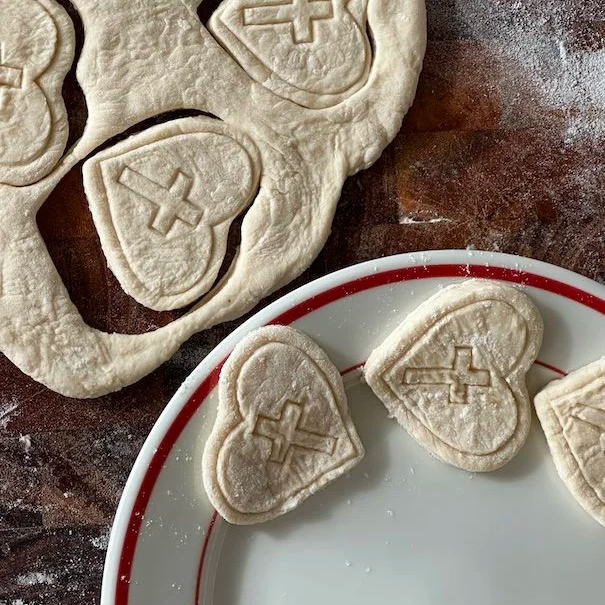
Shape into small rounds, or using a cookie cutter, into hearts. Lightly press or dock with a fork if puffing worries you.
Bake 15 -20 minutes. They should look matte and barely blond at the edges.
How It’s Eaten
Eat one before bed.
Drink no water afterward.
Go to sleep.
The deprivation is intentional.
© Dining in Diaspora